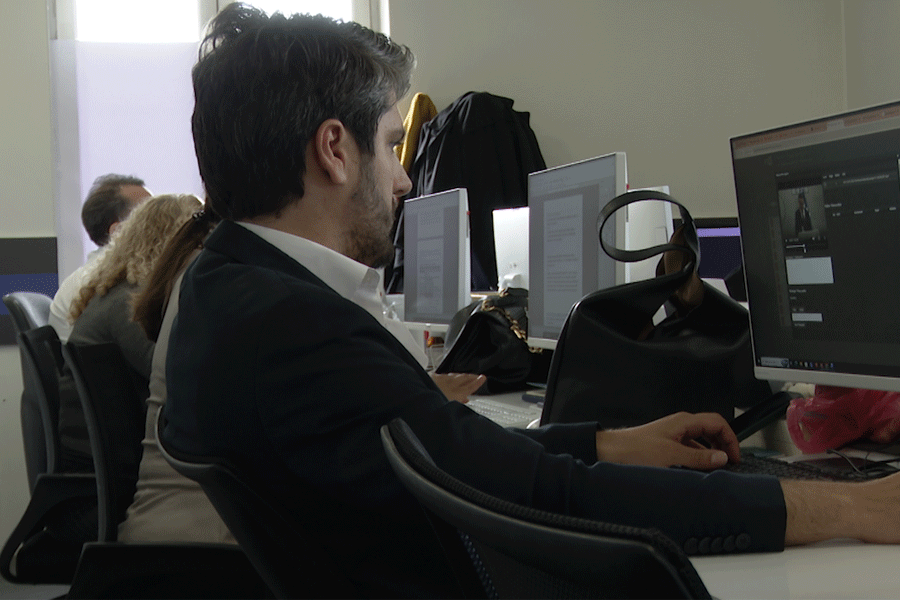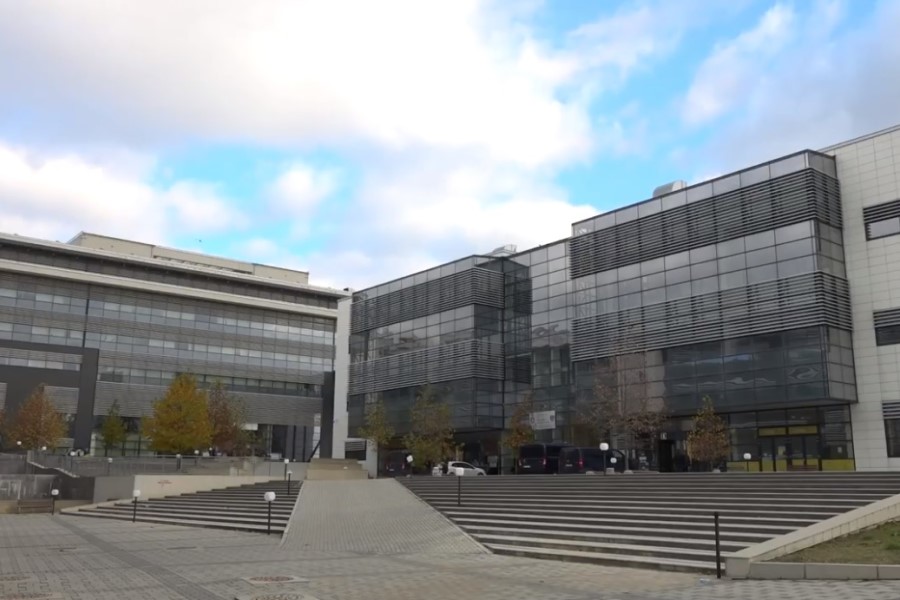
Many languages are spoken and written inside the newsroom and across several others located in two buildings in Prishtina.
Albanians, Serbs, Bosniaks, Gorani, Turks, Roma, Ashkali and Egyptians work across seven editorial desks at Kosovo’s public broadcaster, which stands as a model institution of coexistence and cooperation among communities.
In July this year, Jelena Djurdjic will mark 26 years as part of RTK as a journalist in the Serbian-language editorial desk. She says the diversity and harmony among colleagues is impressive, as journalists from minority-language editorial desks and those from the Albanian-language desk work closely with each other every day.
As an example, she mentions the many occasions when she goes into the field accompanied by an Albanian cameraman and driver.
“In the field, I am always with a colleague who is the driver, Albanian, and with the cameraman who is Albanian. We always have such interesting stories because we complement one another; they help me and I help them with communication, we understand each other. Without them, I would not have been able to build everything I have built over these 26 years. I am very grateful for all of this because my colleagues made me who I am today – a journalist. And I can say this with complete confidence because my movements across Kosovo cover the entire territory, and regarding interviewees, I have both Albanian and Serbian ones. But I want to say that there has never been any problem, everything has always been on a good level,” Djurdjic said.
The cooperation among colleagues regardless of ethnic background has also been experienced for the past 12 years by journalist Visar Shatrolli from the Albanian-language editorial desk.
He emphasizes that throughout this period he has not encountered any issues within the staff.
“RTK is a good example of how different communities living in Kosovo should cooperate. It is a practical example of how we work throughout the day, for instance how we exchange materials among ourselves. Usually when events happen, we as journalists from the Albanian community go into the field, bring the material and upload it into the system, then all the material we collect in the field is used by communities within the newsroom for their news and needs. It is very good and very correct cooperation and during the 12 years I have been here, there has not been any problem,” Shatrolli said.
The Roma-language editorial desk, which was established in 2003, initially had only two journalists, one news presenter, one cameraman and one program editor. However, it was among the first in the world with daily programming in the Romani language. Daut Qulangji has been part of it since the beginning.
“We became the first in the world to have daily programs on public radio and television because around the world there had not been such programming in the Romani language… We are proud of the work we do here thanks to the cooperation we have with all colleagues from other editorial desks and management. We have reached the highest level of professionalism at RTK and we are an example not only in Kosovo for young journalists, but also for other countries,” he said.
For Haris Alia, a journalist from the Bosnian-language editorial desk, RTK reflects the real Kosovo. This is also because cooperation among colleagues is not limited only to work, but continues outside of it.
“Since I live in Prishtina, I often meet all my colleagues, both Albanians and members of other communities. Therefore, our cooperation and multiculturalism are not based only on work relations but also outside television. I have many friends from all communities with whom I socialize, have coffee and spend time,” he said.
Since its establishment, RTK has also had a Turkish-language editorial desk, serving Turkish citizens in Kosovo by providing programming in their mother tongue.
Three years ago journalist Ensar Ismail joined this editorial desk after beginning his career in radio. He quickly adapted to the multiethnic work environment.
“Creating news through a common agenda together with all communities and delivering it to those communities is a great advantage for us. The possibility for issues and concerns of different communities to be broadcast simultaneously on one television station is truly one of the rare examples not only in Europe but in the world. This helps us contribute to one another. We can directly communicate our community’s issues to other editorial desks, whether the Albanian-language desk, Bosnian desk or others. This cooperation and interaction among us shows that RTK differs greatly from many broadcasters around the world and for that we are truly very proud,” he stated.
According to the editor of community programs, Rabisha Muhaxhiri, the secret to strong cooperation lies in work culture, while multilingualism is considered a source of pride for this media outlet.
According to her, there is genuine media coexistence within RTK among editorial desks, where daily cooperation among communities and different languages is very strong.
She adds that besides professional work, there is also a close relationship outside the cameras, with respect for one another’s cultures, traditions and holidays, making the work environment warmer and more functional.
“In reality, it is true coexistence in the media sense, even though most of them have now worked for more than 20 years and we invite one another to celebrations, weddings and different life events. We work in one newsroom, and as you saw, it is always pleasant to enter there, even when you have a somewhat direct message, because besides linguistic diversity there is also diversity of identities, cultures and traditions… Bajram and other holidays bring greetings from home, sometimes sweets as well. I am speaking about things outside the program. Within the program, cooperation is definitely excellent and greatly influences the daily work of the editorial desks. A great appreciation and thanks also go to the majority, in this case the Albanian-language editorial desks, who welcomed the communities and played the role of good hosts, even when some perhaps did not know the Albanian language very well,” she said.
Radio Television of Kosovo was founded in 1999, immediately after the end of the war in Kosovo and the establishment of UNMIK, the United Nations international administration.
Today, RTK functions as a public media service with television channels, radio and online platforms, with the mission of informing all communities in Kosovo in their mother tongues.
This story was produced by the Center for Innovation and Development (CFID) and KosovaPress as part of a joint project with UNMIK aimed at building trust among communities in Kosovo.