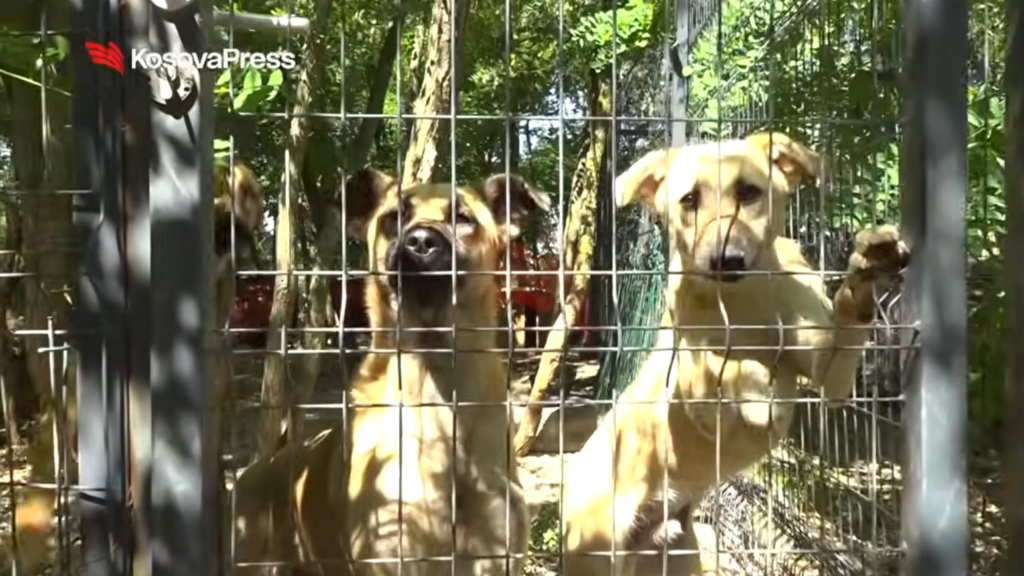
The “Prishtina Dog Shelter” in Gracanica is an example of how the missions people set for themselves in life can overcome ethnic and racial barriers.
Albanian Mentor Gashi, Serb Slavisa Stojanovic and Roma Bajram Jasharaj have joined forces to improve the lives of stray dogs and give them a better life through adoption.
Mentor, who founded the organization 14 years ago, tells the story of how it all began.
“I started doing this humanitarian work with stray dogs 14 years ago. It was a project started by an American in 2012, which lasted for two years. After the project ended, my colleague Slavisha and I started working on our own after learning the job. I was responsible for hiring people, and one of the first people I hired was my colleague Slavisha, and we started working together. I met Slavisha by chance when the project started in 2012. We began working near his house. There was a small incident involving our dog at his home — his rabbits had been attacked. That’s how we got to know each other. I asked him if he wanted to work with us. It was a somewhat funny situation. I liked him as a person and he agreed to work. Meanwhile, Bajrami had lived in Italy, and when he returned, he contacted us and I accepted him,” he said.
Today, the shelter, established as a private initiative by two friends, takes care of around 45 dogs.
Every day, work begins early in the morning with cleaning, feeding and caring for the dogs.
“Never more than 45 dogs because we don’t have the capacity to keep more, and it’s not good to have too many dogs. You cannot feed them all, you cannot treat them all. We mainly sterilize them and return them to where we found them. Anyone who works with animals knows that you have to come early in the morning, clean, change the water, feed them and check if any of them are sick. Then we have fieldwork, where people call us for different cases. If we have the opportunity, we go. Like a case two days ago, when we took a dog with two broken legs, treated it and operated on it. In cases of extreme injuries, we keep the dog until it recovers and give it a chance to find a home,” he said.
In a corner of Gracanica, on land they rent, they spend most of their day together.
Like in any workplace, there are occasional disagreements. But they say these have never been related to ethnicity.
“This is a better environment, there are no houses nearby, and the road is a little higher up. It is a very good place for the kind of work we do.Our cooperation is excellent; we get along very well. We spend the whole day together, more with each other than with our families — from 7:00 in the morning until 6:00 or 7:00 in the evening. Of course, like every organization, family, or any place, there are problems, but we overcome them. Never on a national basis. We are not interested in that, because we do humanitarian work. The three of us happen to know the job, love it and work well together,” Gashi said.
The same feeling is shared by Slavisha Stojanovic, the shelter’s manager.
For him, ethnicity has never been important.
“Who cares about nationality? We are not bothered by that. We are friends because we have worked together for 14 years. We are like a family. Just like with Mentor’s wife — she comes to my house. I go to Mentor’s house for Bajram with my wife. For 14 years, we have been here every day. Every day, from 8:30 in the morning until 6:00 or 7:00 in the evening,” he said.
However, besides caring for dogs, they face another daily challenge — keeping the shelter running.
“Yes, only through donations. Before COVID-19, there were more donations. Now there are fewer, but we love the dogs and we work. We receive small donations — €10, €20, €30, €50. We also get something through Mentor’s Facebook page. With three people, whatever comes in, it is around €200-300 per month. We have the capacity here; now we can accommodate around 50 dogs. We could build more kennels, but we don’t have donations, we don’t have money. It is impossible. How do we get food, how do we pay the veterinarian?” he said.
Stojanovic says the number of abandoned dogs is very high, while every day they try to help those most in need.
“There are many dogs on the streets. Many. We have been working for 14 years and, to tell you the truth, we have definitely helped 2,000-3,000 dogs, through sterilization and adoption. Still, there are many dogs in Pristina and Gracanica. When we go into the field, we check where the dog is. The priority is whether it is sick, whether it has a broken leg or some other injury. We take the dog and go to the veterinarian, and we pay everything ourselves. Most calls are like: ‘There is a dog here, it has a broken leg…’ We go, it becomes a priority, and we help. We also go to Albania and North Macedonia. When we see something on Facebook or somewhere else, we go, take the dog and examine it.”
Several years later, a young man who had just returned from Italy joined the small team at the shelter.
His wish was to open a shelter for abandoned dogs, but because he lacked experience, he decided to join the Prishtina Dog Shelter organization.
“To be honest, I grew up in Italy and came here from Italy, but I immediately saw the problem in Kosovo — there were many dogs. I started thinking about how to solve this issue and wanted to find a solution, but I was very young and I didn’t have experience with dogs because I had never socialized a dog myself. Then I started contacting Mentor, to see how the situation with dogs was, what the process was after the veterinarian, how to take them outside, because we have some dogs that go abroad through adoption. It is going very well,” he said.
When he decided to return and live in Kosovo, Bajrami, who is from the Roma community, did not know Albanian, Serbian or Romani, so adapting was not easy.
But cooperation in an organization built on responsibility toward dogs, rather than differences, made the transition easier.
“For now, we spend more time together. It feels like being at home or something like that. We are together more, and work is going very well at the moment. We are not interested in those things. Our responsibility is only to do the job as quickly as possible and to see success for the injured dogs we have, and hopefully to expand this work as much as possible,” he said.
Every dog that finds a new family is proof that the efforts of these three people have not been in vain. For them, adoption does not only mean a new home for the dog, but also the greatest reward for the work they do every day.
To continue this mission, they rely on donations and welcome volunteers who want to help.
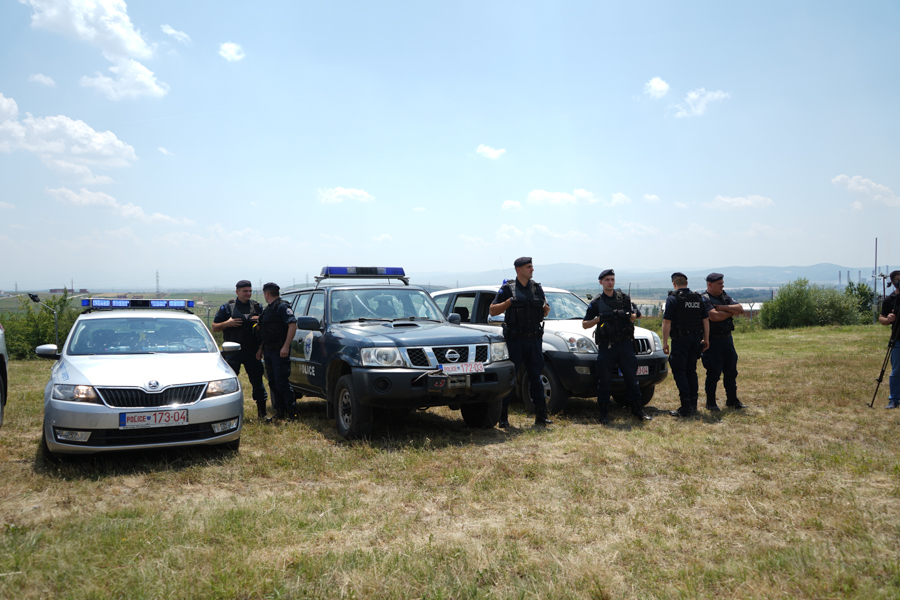
This story was produced by the Center for Innovation and Development (CFID) and KosovaPress as part of a joint project with UNMIK aimed at building trust between communities in Kosovo.