On a small board, the squares are the same for everyone. The pieces do not care who moves them or where their opponent comes from.
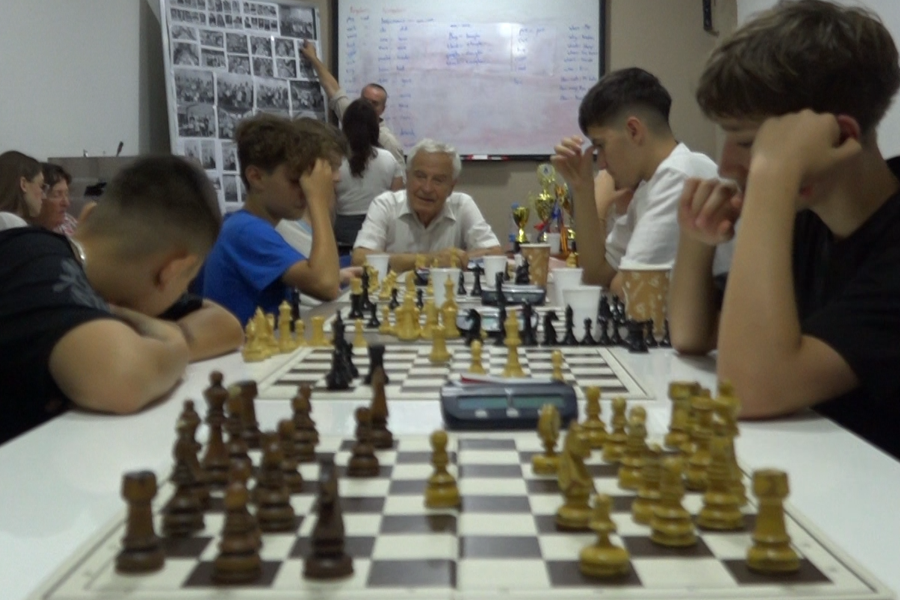
But beyond the game, at the Shadervani Chess Club in Prizren, the board has become a meeting point for children from different communities.
Among them are Hena and Xhan, two chess players from the Turkish community who, at the club, have not only developed their chess skills but have also formed friendships with Albanian, Bosniak and Roma peers.
“I learned chess at home from my grandfather. Then I came here and continued playing together with my friends. Bosniaks, Turks, Albanians, we all came together and played together. I felt very comfortable here. Since then, I have participated in three championships. I came first twice in the U8 category and once in the U10 category,” he said.
For Hena, success in chess is only one part of what keeps her connected to the club.
Alongside competitions and titles, she also highlights the friendships she has made here, friendships that continue beyond the chessboard and outside the game.
“I first learned chess from my father and grandmother. Later, my grandmother enrolled me in this course, where I began developing my chess skills even further. In my first year at the course, I came first in the U8 category. In the second year, I came first in the G10 category and participated in the European Championship in Montenegro. In the third year, I again came first in the G10 category. This year, I will also participate in the European Championship, which will be held in Greece, on the island of Crete. Here, Turks, Albanians and Bosniaks all socialize together. I also feel very comfortable and good here,” she said.
And the game does not always end when the pieces are put away. For some of the children, it has only been the starting point for forming new friendships.
One of them is Muhamed Redza from the Bosniak community.
At the club, in addition to chess, he has found a new circle of friends with whom he communicates every day.
“I came third in the Kosovo Chess Championship and I am a member of the Shadervani Chess Club. I learned to play chess through my friend. Here, I socialize with Alion, Efa, Ensar and Hena,” he said.
Over time, chess has also become a way for the children to communicate with one another and even learn things they did not know before.
Bamir Ensar Zherka says that, in addition to improving his chess skills, participating in the club has brought him closer to new people and helped him learn some of his friends’ language.
“To be honest, participating in the club has been the main thing. Before, I knew how to play, but now I really know how to play… The cooperation, to be honest, I didn’t know Turkish before, but here I have more or less learned Turkish. And besides that, with those who, for example, speak Bosniak, sometimes we speak English or, with the help of a coach, we translate… For example, Artin and I have gone out and gone for tea… It was very nice, and we talked about many different topics. We didn’t talk only about chess because when we are at the club, we usually talk only about chess,” he said.
The friendship Bamiri has formed at the club has not remained only in his words.
For his family, too, this experience has been proof that chess can bring children closer together, regardless of which community they come from.
“Chess is a game that truly contributes to children’s development. And I ask mothers and other parents to support their children as much as possible, so that they spend their time with logical games, rather than electronic games… There have been no obstacles; on the contrary, Prizren is a place of different cultures,” she said.
The friendships that began around the chessboard have, over time, also become a means of communication among the children
For Valmor Bardhi, president and coach of the Shadervani Chess Club, this is precisely where one of chess’s values lies: its ability to bring people closer together, even when they do not speak the same language.
“Chess is known as a sport that connects people; it is a bridge between communities. It brings communities together. And interestingly, they have also started learning each other’s languages. By listening, talking and communicating. Or those two who do not know each other’s languages, for example, one…”
“…one speaks Turkish and the other speaks Albanian. When they cannot understand each other, they switch to English and are able to communicate and understand each other… For example, in this case, we have Muhamed, who is Bosniak, and Hena, who is Turkish, playing against each other,” he said.
But this spirit of cooperation is also part of how the club itself has been built.
“Shadervani” was established in January 2023 and, within a short period of time, has brought together chess players from different communities.
“The only club in Kosovo where we have four communities. We have Albanians, Turks, Bosniaks and Roma. Since the city of Prizren is multiethnic, and since I also know all three languages spoken in Prizren, as well as English, we communicate in English too. Since it is not easy to use three languages, we also have Roma members who know Albanian, so we are able to explain our training sessions and lectures during practice in all three languages. All communities have participated in the Kosovo Championship. The Turks are the Kosovo champions,” he said.
This bridge between communities is being built in a space that the club itself does not permanently own.
The Shadervani club currently does not have a dedicated space for training. The children gather and practice in a borrowed space which, despite its conditions, has become a place where they regularly meet.
To be honest, we barely managed to find this place to practice… There are 30 children who are interested. But another 20 are also interested, and where are we supposed to put them? We have not received support from the municipality. This year, we have not received any donation from the municipality. This year they promised a very small amount, but even the chairman has not received it yet. Some of us who are part of the Presidency and the Board are helping with whatever we can. But this does not lead to major results among the age groups when you do not have enough space, and this place is not healthy for young people either. There is no fresh air, as you can see how hot it is. There is no air conditioning and there are no windows,” he said. – 28:10
And precisely in this space, where Albanians, Turks, Bosniaks and Roma now meet, the history of chess in Prizren has even deeper roots.
This is also confirmed by Enver Gjurgjehallo, a chess veteran who has been part of the sport in the city for years.
He recalls that in the past, chess players from different communities also played on the Prizren team.
“When I played, the team had 10 candidates, 10 participants. There were six seniors, one woman, two juniors and one pioneer. There were two Serbian seniors. There was also one Serbian junior who played for about five or six years. There were also Bosniaks; in fact, one of them had the greatest success at that time. He received the FIDE Master title in Switzerland and played for Prizren. We did not have Turks back then as we do now. There were no Roma either. Now the team has Albanians, Bosniaks, Turks and Roma. They get along well, and within these age groups I have not seen anything that goes against our culture. They have good upbringing at home and behave well toward one another. And as a chess veteran, I am pleased,” he said.
In addition to her role at the club as a chess player in the women’s group, Vjosa Curri-Simitci says that cooperation among children from different communities has become a natural part of their everyday lives.
According to her, even when language becomes a barrier, children find other ways to understand and cooperate with one another.
“We do not distinguish them, not at all, based on where the children come from. To us, children are all the same. The door is open to them, and they feel very comfortable here… For me, it is very easy because I speak the languages and am familiar with other communities. We have shared our lives together. Prizren is a place where all the communities that exist in Kosovo are present. We have them here. We have always cooperated and lived together, so I have no difficulty in that regard. In fact, we can also build bridges and empower the girls even more,” she said.
Vjosa Curri-Simitci is also the coach of Kosovo’s women’s team and this year will represent Kosovo at the Chess Olympiad in Uzbekistan.
At the Shadervani Chess Club, two female chess players have been crowned Kosovo champions in their respective age groups this year alone, while Hena Simitci has won the G10 title for three consecutive years.
Both will represent Kosovo at the European Championship in Greece.
But beyond the titles and medals, something else is being gained at this club that cannot be measured in points.
For the children, the game has brought something beyond competition: friendship, communication and connections among communities.
And although the club still does not have a permanent space, the space they have created among themselves is growing ever larger.
This story was produced by the Center for Innovation and Development (CFID) and Kosovapress, as part of a joint project with UNMIK aimed at building trust among communities in Kosovo.