Only a few steps separate them from one another.
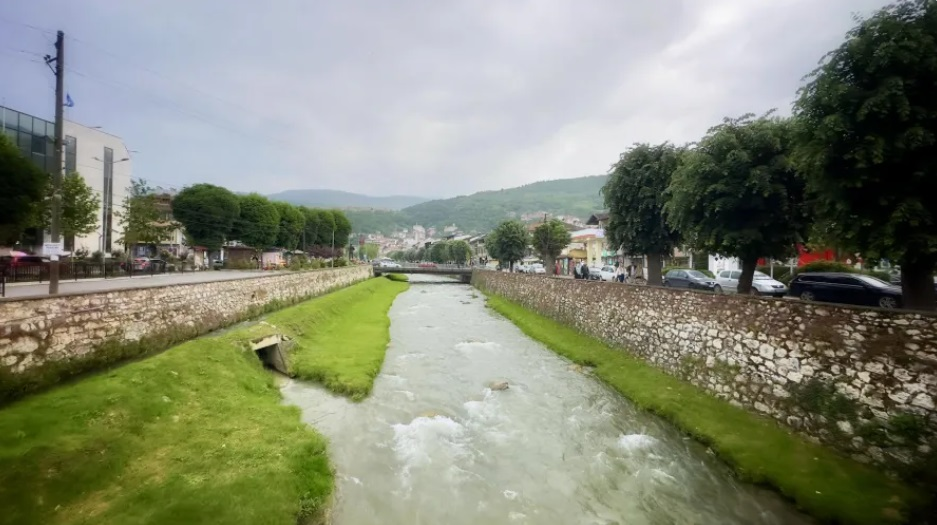
The Catholic Church, the Orthodox Church, and the Mosque stand close to one another in the heart of Prizren. These places of worship are not merely monuments of faith, but evidence that different communities have lived and continue to live side by side.
“I can say that Prizren is an example because historically, many cultures have intersected here, a crossroads of cultures. Throughout the centuries, Prizren has historically been dominated by Christianity and Catholicism, and later, during the period that followed, the Islamic faith arrived. As we know, before the Ottoman Empire, there was the Serbian Empire, so they have coexisted here until today… What makes it special is the fact that Albanians of the Catholic faith, Albanians of the Islamic faith, Serbian Orthodox people live here, increasingly fewer in Prizren, Bosniaks, Roma… If there is tolerance, then this is the place where it exists,” he said.
The city of Prizren is a unique example of interfaith harmony, and according to the Vicar General of the Diocese of Prizren, Shan Zefi, the close proximity of the religious sites has played a major role in fostering a spirit of mutual respect.
“From an aerial perspective, the Catholic Church, the Orthodox Church, and the Mosque are about 50 meters apart. We also have the Jewish community’s cultural center next to the cathedral, and this has had a great impact… This has given Prizren a different image because, especially from the west and the east, people continuously come to this church. They come wearing head coverings and dressed appropriately, setting a good example and knowing that they have come to a sacred temple… This proximity is increasingly helping to break down the mentality that everything belonging to a culture is exclusively ours and belongs only to the citizens of Kosovo,” he said.
The same spirit is described by the Chairman of the Islamic Community Council in Prizren, Valon ef. Ibrahimi. He says that different communities not only live alongside one another, but also continuously cooperate to preserve the harmony that characterizes the city.
“We always have various meetings, which we are happy about, but we also hold these meetings to further strengthen our relationships and the different cultures that exist here. This role is also appreciated by others who come to visit the city of Prizren… As you know, the city of Prizren is known for its high cultural values, as well as its traditions and customs. There are communities that differ in their religious beliefs, but they respect one another, and we have a very strong and genuine harmony in this regard… Whenever there is something that would benefit the city, society, and coexistence, we try to address it with the utmost seriousness,” he said.
For him, the fact that the religious sites are located close to one another is evidence of a harmony cultivated across generations and one that is also passed on to future generations.
“The very fact that the church, the mosque, and the other communities, which have their own beliefs and pray in their respective places of worship, exist side by side shows that there was a broad religious harmony in the past as well. We also try to maintain, cultivate, and pass this on to the future generations who come after us,” he said.
But the spirit of coexistence in Prizren is not limited to places of worship.
It can be felt in every alley of the old city, where the history, culture, and traditions of different communities have intertwined for centuries.
According to tour guide Gjeni Krasniqi, it is precisely this richness that makes Prizren unique in the eyes of visitors.
“Prizren is a multiethnic, multicultural place where different communities live, for example Turks, Bosniaks, a small percentage of Serbs, and a large percentage of Albanians. For many years, we have had both cooperation and harmony between the communities. This has also been reflected in the tourists who come here, who are amazed or left with a very strong impression,” he said.
The road connecting the churches and the mosque also passes by the shops of local artisans.
Here, different faiths, languages, and traditions meet every day, not only in the city squares, but also in workshops where crafts are preserved from one generation to the next.
An important role in this cultural mosaic is also played by the “Orkide” Women’s Association, which brings together women from different communities to preserve traditional crafts and traditions characteristic of Prizren.
“We are an association created by women from Prizren… We organize courses and training in various fields for women… The women who participate here are, in most cases, involved on a voluntary basis… There is very good communication and a very strong bond among us… The women are very happy with these activities. They are happy that such an association exists in Prizren because they have the opportunity to attend training and gain new knowledge… At the same time, they also make new friendships,” she said.
So far, the association has organized courses in many fields, including handmade home decorations, painting, woodworking, felt work, jewelry design, relief work, and courses on traditional Prizren embroidery.
For Marica Tatar, who is originally from Croatia and has lived in Prizren for years, the association is not only a place where women learn handicrafts, but also where they talk about their problems with one another.
“I live between Prizren and Croatia… I come here with great pleasure, and I really enjoy handicrafts. I am very happy. All the women are very close to one another. We don’t only meet here, but outside as well, in the city. We have coffee, talk, and have a great time… I live between Prizren and Croatia… When I am here, I come to the association, talk with the women, and we work together, whatever needs to be done… People here are very close to one another, whether they are Bosniaks, Albanians, or Turks. We all live well together. Most of us speak three languages,” Tatar said.
Crafts trainer Venera Rada also says that differences have never been an obstacle in the association.
“I don’t believe there is any problem at all. We are used to this environment; we all live together in Prizren, so we don’t make any distinctions… At the association, we know each other by name, not by affiliation. There are no problems between us, and we make no distinctions,” she said.
Upon completing these courses, as well as courses offered by other associations operating in Prizren, women gain experience and are prepared to open their own businesses.
One of these women is Gylsen Halabak, who, after completing the courses, opened a traditional clothing shop together with a woman from the Albanian community.
Through this initiative, Halabak shows that in the city of Prizren, cooperation is possible on an even larger scale.
“The idea came to us after my mother saw an announcement for a course organized by ‘Ec Ma Ndryshe’ and taught by our partner, Sebahate Kabashi. Considering that Prizren is a very multiethnic place, we wanted to serve every community without facing any challenges,” she said.
Zejxhane Celina is another woman from the Albanian community who has opened her own business.
For her, craftsmanship is not only a profession, but also a way to build friendships and bring communities closer together.
“We have cooperated a lot, and we continue to cooperate. When we held courses, they were multiethnic courses because, as is known, in Prizren we have Albanians, Turks, Bosniaks, Roma, and Egyptians. So, for us, this is nothing unfamiliar because we have always lived in a multiethnic environment. We have known, and still know, how to respect a person of another faith or another nationality. For me and for the society around me, we get along very well with people from other communities,” she said.
She says coexistence is reflected not only in relationships between people, but also in the knowledge of multiple languages, because, according to her, what brings the people of Prizren together is their ability to speak one another’s languages.
But coexistence in Prizren is preserved not only through tradition, but also through institutions that work to support it.
One of them is the Chamber of Artisans and Entrepreneurs of Prizren, which for years has brought together artisans from different communities and created opportunities for professional development.
But beyond business support, according to its chairman, Afrim Tejeci, the Chamber’s greatest value is that it reflects Prizren’s multiethnic character.
“Given that the city of Prizren is a multiethnic city, the Chamber itself is registered with the relevant ministry as a multiethnic chamber. Our leadership includes members of every community, and we have a considerable number of artisans and craft workers, as well as many women. For example, our women’s department has more than 120 female members, including 18 to 20 from the Roma community, 11 Bosniaks, and more than 20 Turks. We are open to everyone, as the Chamber is registered as a multiethnic chamber. Therefore, regardless of community, we want to preserve this tolerance, since the city of Prizren has historically been a city of tolerance and coexistence, and we work with communities in general without any problems,” he said.
For Tejeci, craftsmanship has also served as a bridge for cooperation among young people who have been involved in projects and supported in developing their businesses.
“It is fortunate that young people today are very committed to crafts, which motivates us to work even harder for this excellent generation. Since there is now great interest in learning trades in vocational schools, we have also established a youth department. In partnership with schools, students are part of the Chamber of Entrepreneurs and Artisans. We have organized four or five seminars, and we have sent four groups abroad to see how these crafts are practiced internationally, including to Koblenz, while two groups went to Tirana to see how work is carried out in companies there,” he said.
The Secretary of the Kosovo Chamber of Artisans, Afrim Rada, shares the same assessment. According to him, craftsmanship has not only been a source of livelihood, but also one of the pillars that has kept coexistence alive in Prizren.
“Cooperation among different communities is so deeply intertwined that it is not something that needs to be explicitly expressed. It is a tradition that has continued for many years, because such activities were characteristic of particular communities. Coexistence in Prizren has created closeness among artisans, and they are generally very united. The artisan community, regardless of national affiliation, is one big family,” he said.
The proximity of churches and the mosque in the historic center of the city, along with cooperation among institutions, associations, and artisans, have made Prizren a symbol of dialogue, tolerance, and respect among communities in Kosovo.
Each of them preserves their own craft tradition, but they all share the same belief: that Prizren’s heritage is built not only from the stones of the city, but also from the people who work and live together.
This story was produced by the Center for Innovation and Development (CFID) and Kosovapress, as part of a joint project with UNMIK aimed at building trust among communities in Kosovo.