An exhibition showcasing the history and culture of the Roma, Ashkali and Egyptian communities is just one of the ways in which bridges between communities are being built.
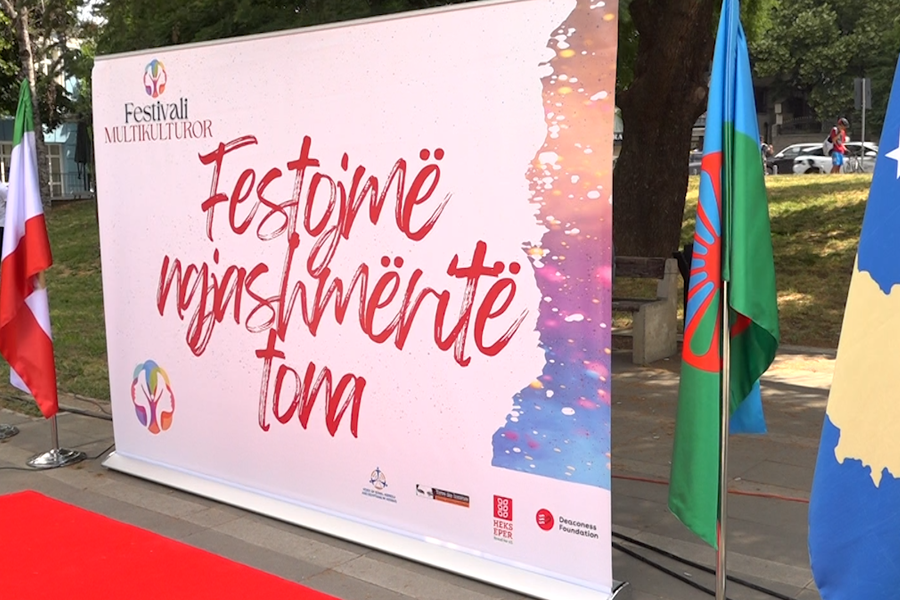
At the Multiethnic Festival, held this summer, these stories were brought into the public space through exhibitions and activities aimed at challenging prejudice and stereotypes.
But for the organization, inclusion does not end with a festival.
It continues through cooperation between communities, activities that create skills and opportunities, and support for young people in education.
“The Multiethnic Festival is an activity that we have been organizing for the past eight years. Naturally, like any festival, it comes with its own challenges, both in terms of engagement and in terms of the message we want to convey,” said Denis Avdiu, organizer of the Multiethnic Festival.
This time, part of that message was conveyed through a mobile exhibition that travelled from one city to another, bringing the history, culture and traditions of the communities to people across Kosovo.
But the festival is not only about showcasing the culture of these communities.
Through cooperation with other communities, the aim is to create more space and opportunities for Roma, Ashkali and Egyptian communities to participate fully in society.
“The inclusion of the Roma, Ashkali and Egyptian communities is, of course, one of our goals in society. By cooperating with all communities, we are trying to ensure that Roma, Ashkali and Egyptian communities have an influence in society and are included in every aspect, starting with employment, participation in cultural activities, and the promotion of their cultures. The Roma, Ashkali and Egyptian communities are also very cooperative in this regard,” he said.
According to the Executive Director of Voice of Roma, Ashkali and Egyptians, this spirit of cooperation is also reflected in the participation of people from other communities.
“We have always had very strong and diverse participation in our festival. In addition to Roma, Ashkali and Egyptian communities, we have also welcomed artists and members of the Albanian, Bosniak, Turkish and other communities. Through their performances, they have sought to convey a message of equality, similarity and the shared values that this festival has been promoting in our country for the past eight years,” he said.
One of VoRAE’s partners is Terre des Hommes, with whom the organization implements activities aimed at promoting social inclusion and the integration of communities.
For Pajtim Zeqiri from Terre des Hommes, an important part of this process is ensuring that communities are not only beneficiaries, but also active participants in shaping and creating activities.
“It is truly essential to have the active participation of communities. I believe that these communities have taken part not only in organizing the festival, but also in contributing ideas. When something is created together, it becomes a process of co-creation, and the results are always better,” he said.
Inclusion does not remain limited to the festival stage.
As part of the festival, women and girls also had the opportunity to take part in practical activities, where they learned new skills and exchanged experiences.
Among them was 19-year-old Dashurije Jahja from Mitrovica, who has been participating in VoRAE activities for the past year.
During the activity, she joined other women in learning embroidery through an engaging and hands-on approach.
For Dashurije, this is just one of the experiences that has added to the skills she has gained through her participation in the organization’s activities.
“It has helped me a lot because we really enjoy these activities. I have sewn several dresses, including some for my mother, and I have also started working from home. There is also a makeup course being held by someone I know in Mitrovica, and I am continuing that as well, together with my uncle’s friends and my own friends,” she said.
Alongside tailoring, Dashurije is currently also attending a makeup course, and she says that in the future she would like to start a business of her own.
“I found it very interesting because we really enjoy learning new things, and we have completed other courses as well. I completed a tailoring course, and now I am taking a makeup course. We would like to open a makeup studio, and we could also start something in design, making dresses. We would really like to do that,” she said.
Opportunities for inclusion extend beyond cultural and practical activities.
Education is another important space where efforts are being made to create equal opportunities.
At “Haxhi Zeka” University in Peja, the project “Support for Roma, Ashkali and Egyptian Community Students” provides students with support not only in their academic journey, but also in developing their personal and social skills.
Mentor Nora Dragaj is part of this process, working directly with the students.
“Through our work with the students, we have tried to provide not only academic support, but also personal support throughout their studies. I believe this has had a significant impact on them, because we have organized various academic trainings, held meetings with other students, participated in different training sessions, and organized extracurricular activities. These activities have helped them develop their soft skills, communication and teamwork skills, as well as many other abilities, so that they do not feel different or left behind, but simply feel equal to all other students at the university,” she said.
For Nora, an important part of this process has been building trust with the students.
Through regular meetings and continued communication, she says, the students have gradually become more comfortable discussing the challenges they face.
“As a mentor, I have also been very happy that we have managed to bring these students closer to us. We have reached a point where they feel comfortable enough to share the challenges that are important to them, allowing us to work together to find solutions to those challenges,” she said.
One of the students taking part in the project is Ujkan Kameraj, a second-year student at the Faculty of Tourism and Hospitality Management.
For the young Egyptian student, participating in the project has also provided an opportunity to connect more closely with other students and build stronger relationships and cooperation.
“Thanks to her [Nora’s] commitment and the time she spent with us, she helped us socialize, brought us closer together, and gave us the opportunity to cooperate with other students and receive support with our studies,” he said.
For Ujkan, the experience has also brought him closer to other students.
He says cooperation at the university is now strong, and that students from different communities take part in a range of student activities.
Ultimately, inclusion is not built through a single festival or activity.
It is created through connection, cooperation and equal opportunities – every day, within the community, at school and throughout society.
This story was produced by the Center for Innovation and Development (CFID) and Kosovapress, as part of a joint project with UNMIK aimed at building trust among communities in Kosovo.