He won fans over with goals like these.
Alongside good performances, it is also the jersey that matters most on the football field, more than ethnic background.
For young footballer Belgin Jashari, sport became the place where he found support, respect and confidence.
This was also proven after the young Ashkali boy was physically and verbally attacked during a match because of his ethnic background.
The reaction of his teammates, the club and the sports community turned into a clear message against prejudice and in support of coexistence.
“The team welcomed me very well at that moment. They saw me as equal; they did not make any distinction. Everyone supported me, pushed me forward, motivated me and gave me a lot of encouragement. It was the team that gave me the motivation to keep moving forward,” he said.
The support he received from his teammates, football players and citizens strengthened his belief that prejudice can be overcome when people stand together.
“I felt very good because I did not expect it. I also felt very good because I was supported by experienced footballers, both from Kosovo and from the Albanian national team. The best thing that made me feel good was that Edon Zhegrova also gave me his boots. I thank him very much. There were also people who invited me to dinners and lunches, who tried to make me feel better and helped me forget the incident,” he said.
Belgin Jashari began his football journey at KF Fushë Kosova, initially as a ball boy. It was there that the coach noticed his talent and opened the way for him to become part of the team.
Today, he is one of the most promising young footballers.
“When it comes to football, I started when I was very young by coming to watch Fushë Kosova play, and later I became involved with Fushë Kosova’s Super League team. I liked the team and I came with my friends just for fun. Then the club’s coach gave me the opportunity to collect balls, to be a ball boy. At that moment, there was an attack from the opposing team, I took the ball to hold it and passed it back to one of my teammates. Then I started dribbling, doing skills and trying different things. Over time, the director noticed me, he saw me doing skills…”
“Then he gave me the opportunity to come and start training. When I started training, the first week was very joyful for me. I tried with all my abilities to give my very best…”
“The biggest thing I liked was that the coach believed in me the most. More than anyone else, I had someone who supported me; for example, whether I played as a left or right winger, I had my coach Artan Reshiti as my support,” he said.
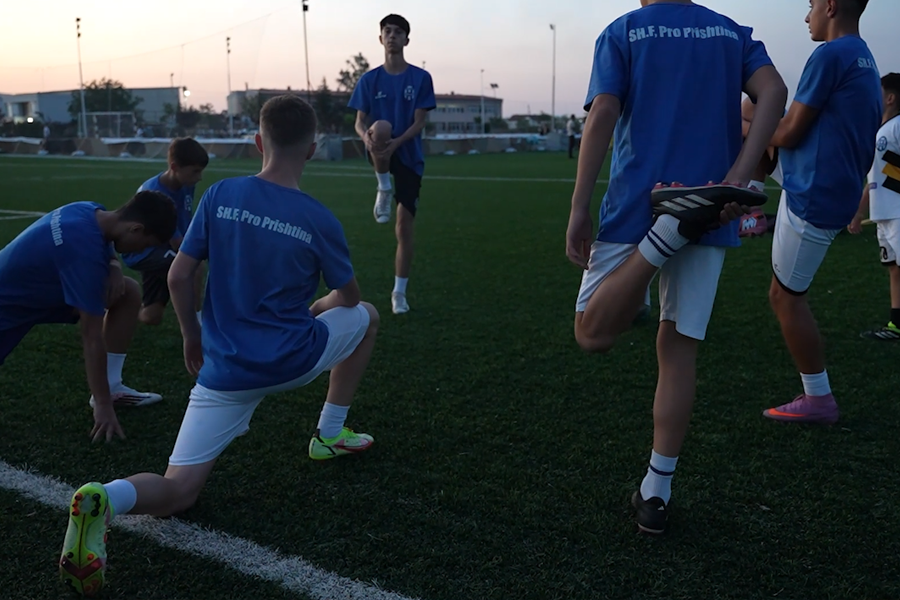
At the Pro Prishtina football school as well, differences remain outside the lines of the green field.
For them, the jersey is the same for everyone, while the language that unites them is running after the ball.
There, coexistence is not learned in theory, but is built through every pass, every training session and every match.
Coach Shkumbin Sopjani says that in the academy founded in 2021, there is no place for ethnic divisions, but only for talent, discipline and respect.
“We have children from different communities. I am very proud of their achievements. One of them is Bilalli. Bilalli is a player who, hopefully, will make us proud one day and represent the colours of our national team. We have some others as well. I am very satisfied with them, especially with their behaviour; they are correct. At Pro Prishtina, there is also that spirit where everyone is under the umbrella of Pro Prishtina and everyone fights for the Pro Prishtina flag. Here there are no ethnic divisions; they are all one family and everyone gets along well. We have also participated in international tournaments where members of minority communities have taken part. Hopefully, this continues, and in all the tournaments where we have participated, they have represented us in the best possible way. I am proud that our Pro Prishtina football school also includes other communities,” he said.
For Sopjani, this spirit has become even stronger in recent years.
He says that hesitation among children from communities to get involved in sports has significantly decreased and that ethnic differences are increasingly being replaced by respect and cooperation.
“To be honest, considering that I am part of a school where different communities participate, I can freely say that this has completely disappeared. Not only that, but it has changed a lot, a lot, a lot for the better. Those divisions of ‘you are like this’ or ‘you are like that’ no longer exist. The main thing is that all children are equal, and hopefully in the future this topic will not even need to be discussed anymore,” he said.
For the Pro Prishtina coach, sport is one of the best ways to bring children together and keep them away from prejudice.
“My message to them would be very clear: The more they engage in sports, the better. Sport is an opportunity that socializes children; sport is an opportunity that prepares them for life. It prepares children for how to behave in society, how to behave on the streets and how to behave everywhere else. Sport also keeps them away from certain paths that children should not be on,” he said.
Among the talented players at PRO Prishtina is Bilall Stollaku, a member of the Egyptian community.
For him, football is not only a sporting activity, but also a place where friendships are created and where he shares the best moments with his teammates, especially during training sessions.
“Most of the time we do fitness training and exercises with the ball… We have a great time here. We get ready for training, get into the van, joke around with our friends and enjoy ourselves together,” he said.
Part of this club is also 11-year-old Adis Mustafa, from the Roma community, who says that the welcome he received from his teammates at the beginning will remain in his memory for a long time.
“Very good, very nice. Those who knew that I was from the community made me very happy because they told me: ‘You don’t need to be afraid, you don’t need to worry about anything, we will protect you.’ They are very kind and you should not treat anyone badly,” he said.
For him, the friendships created at the club continue outside of training sessions as well, while his message to his peers is not to give up on their passion and talent, regardless of their ethnic background.
The same message is shared by Erdis Sopjani, who has been training at Pro Prishtina for six years.
“I was 5 years old when I started football, training on a simple field, and later I started professionally with football teams… Everything is fair, everything is the same. We respect them… there is no difference. We welcomed them well, greeted them with our hearts, spoke kindly to them and gave them encouragement,” he said.
Kron Bekolli also believes that football brings children together regardless of their background. He says there is no place for prejudice in the team.
“Our cooperation with them is very good. We have a great time together and we do not have any conflicts. I have tried to set an example for others, to bring them closer because they are the same as us,” he said.
The inclusion of children from different communities in sports is supported not only by clubs, but also by the Municipality of Fushë Kosovo.
The Director of Sports, Ylber Kelmendi, says that in the city’s clubs it has already become normal for members of different communities to train and compete together.
“No, there have been no problems, there are no problems. They are extremely welcome. Even at the Fushë Kosova Football Club, there are young football players who are members of different communities and who play together with Albanians. We also have this in other clubs; for example, at the Pro Prishtina Football School, there are football players from different communities and they are excellent. There is no division whatsoever between Albanians and members of the Ashkali and Egyptian communities,” Kelmendi says.
He estimates that over the years, cooperation between communities in sports has become even stronger, as clubs have created an environment where all children are treated equally.
I think they have seen that there is no problem and that everyone is equal. This is because most Albanians and sports clubs, which are mostly led by Albanians, are now welcoming them in a fantastic way, so there is no difference. Those who want to work, those who want to engage in sports, have open doors and have the support of the Municipality of Fushë Kosovo,” he adds.
Kelmendi says that the municipality is also expected to benefit from a UEFA-supported program, through which children will have the opportunity to train for free and receive the necessary sports equipment.
In the end, the message coming from the football field is stronger than any prejudice.
The story of Belgin Jashari, the friendships created at Pro Prishtina, and the support of local institutions prove that sport can build bridges where differences often create divisions.
Therefore, when the ball starts rolling, the jersey becomes the only identity that matters.
When the jersey becomes the only identity, prejudice stays off the field
This story was produced by the Center for Innovation and Development (CFID) and Kosovapress, as part of a joint project with UNMIK aimed at building trust among communities in Kosovo